The Unsung Hero of the Digital Age: Unpacking the Brains of Our Servers
- Home
- Blog
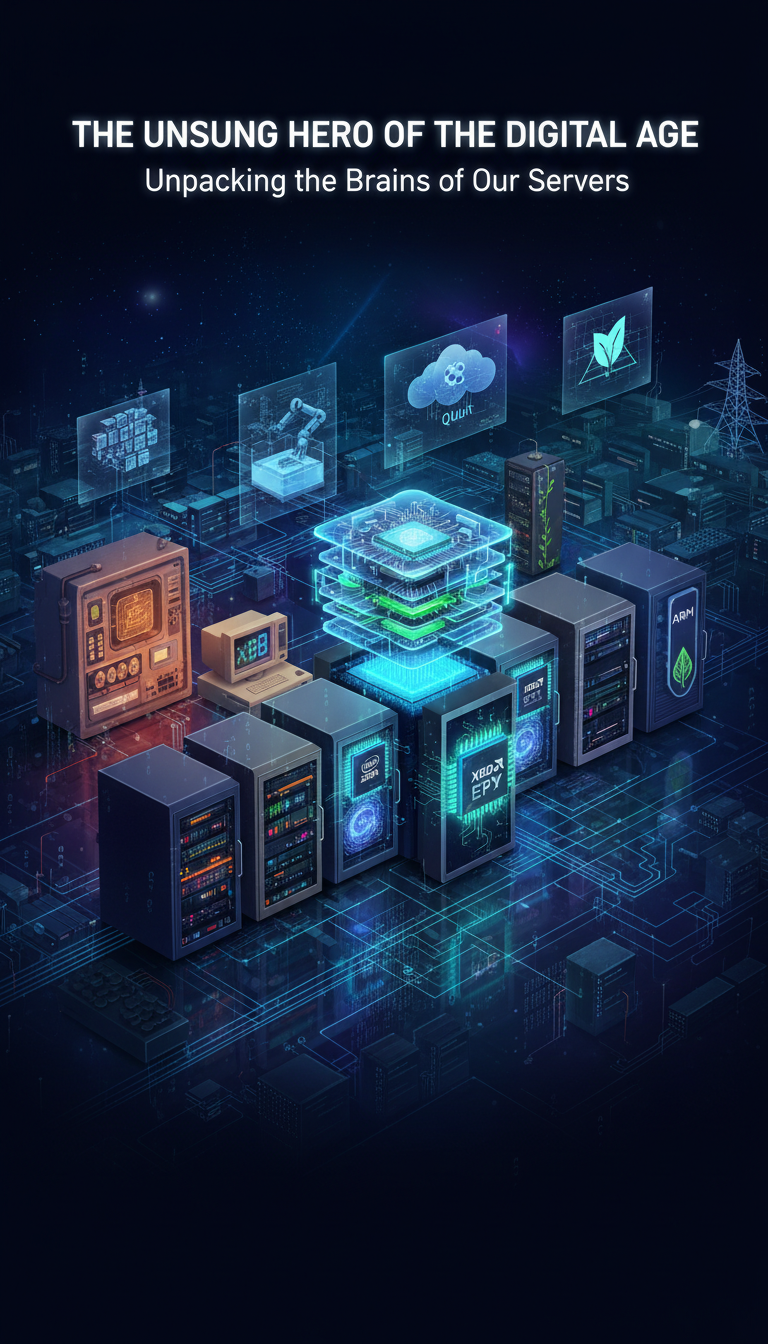
Ever wonder what makes the internet go? What breathes life into the ethereal cloud, allowing you to binge-watch cat videos or collaborate on that crucial spreadsheet? It’s not magic, though sometimes it feels that way. It's the server CPU, that humble, often overlooked, yet astonishingly mighty component lurking in the bowels of data centers worldwide. Consider it the ultimate multi-tasker, the tireless brain orchestrating every digital operation we take for granted. Without its constant calculations, our intricately interconnected world would grind to a screeching halt, leaving us stranded in a digital wasteland. Let us delve deep into the enigmatic world of these silicon powerhouses: exploring their essence, tracing their lineage, identifying the frontrunners in the technological race, and peering into the future to glimpse the wild technological marvels that await.
A Blast from the Past: The Server CPU's Epic Evolution
The story of the server CPU is a fascinating journey through technological epochs.
From Room-Sized Giants to Mighty Miniatures:
In the primordial days of computing (think 1950s-70s), "servers" were monolithic mainframes, behemoths that occupied entire rooms, humming with vacuum tubes and consuming enough power to light a small town. By the 1980s, we witnessed a shift towards more compact, desktop-like machines. The 1990s heralded the era of rack-mounted servers, epitomized by Intel's game-changing Pentium II Xeon, a watershed moment that began to shape the modern data center landscape.
The x86 Dynasty Takes Hold:
Intel's Xeon chips ascended to become the undisputed kings of the server realm, introducing pivotal innovations like Error-Correcting Code (ECC) memory, a bulwark against data corruption, and larger caches, crucial for maintaining server stability and responsiveness under intense workloads.
More Cores, More Power (and Virtual Reality!):
The dawn of the 21st century ushered in the multi-core era. CPUs suddenly possessed the ability to juggle a myriad of tasks simultaneously, no longer constrained by single-threaded execution. This paradigm shift paved the way for 64-bit computing and the meteoric rise of virtualization – the bedrock of cloud computing as we know it.
AMD's Epic Comeback:
For a considerable period, Intel reigned supreme. Then, in 2017, AMD staged a remarkable comeback with its EPYC processors, packing unprecedented core counts, expanded memory support, and a formidable performance profile, directly challenging Intel's long-held dominance.
The ARM Revolution:
No longer confined to the realm of smartphones, ARM-based processors, celebrated for their exceptional power efficiency, began to infiltrate data centers, heralding a greener, more sustainable future.
Today's Battleground: Who's Winning the Server CPU Wars?
The modern server CPU landscape is a dynamic arena of fierce competition and relentless innovation.
The Big Three Showdown:
- Intel Xeon: The established heavyweight champion, wielding its legacy and extensive ecosystem, yet facing increasing pressure from formidable contenders.
- AMD EPYC:The ambitious challenger, relentlessly chipping away at Intel's market share with its compelling core counts and attractive performance-per-dollar proposition.
- ARM (Graviton, Ampere, etc.):The agile contender, experiencing rapid growth, particularly within the cloud, thanks to its exceptional power efficiency and specialized architectures.
Why the Shake-Up?
The crux of the matter lies in the intricate balance between raw computational power, energy efficiency (data center electricity bills are an ever-present concern), and the sheer number of processing "brains" (cores) that can be integrated onto a single chip.
How They Actually Work (Simplified!):
Ever pondered the inner workings of a CPU? The "fetch-decode-execute" cycle forms the bedrock of its operation, relentlessly executing billions of instruction cycles every second to bring our digital world to life.
Hot Debates & Burning Questions in the Server Room
The server room is not merely a repository of hardware; it's a crucible of debate and critical questions.
The "More Cores" Conundrum:
Is the relentless pursuit of ever-increasing core counts the optimal path to enhanced performance, or does it eventually succumb to diminishing returns and introduce complexities in software optimization and resource management?
x86 vs. ARM: The Efficiency vs. Ecosystem Face-Off:
Can ARM's inherent power-sipping characteristics truly overcome x86's well-established software compatibility and extensive ecosystem, or will x86 continue to hold sway due to its legacy and widespread adoption? The debate continues to evolve.
The Environmental Elephant in the Data Center:
- Power Hungry Beasts:Servers, particularly those powering AI workloads, consume electricity at an alarming rate, exacerbating carbon emissions and placing strain on electrical grids.
- Water, Water Everywhere (for Cooling): Maintaining the thermal equilibrium of these high-performance chips necessitates massive amounts of water for cooling, raising significant sustainability concerns.
- E-Waste Mountain:The rapid upgrade cycles inherent in server technology contribute to a growing accumulation of electronic waste, demanding innovative recycling and disposal strategies.
Security Nightmares You Don't Want to Have:
The specter of hardware vulnerabilities looms large. The exposure of sensitive data by vulnerabilities like "Meltdown" and "Spectre" in modern CPUs serves as a stark reminder that even the most fundamental components of our digital infrastructure are susceptible to exploitation.
The Ghost of Planned Obsolescence:
Are manufacturers deliberately shortening the lifespan of CPUs through strategic software updates, perpetuating an endless upgrade cycle and generating excessive waste? This question raises ethical considerations about sustainability and consumer responsibility.
Peering into the Crystal Ball: What's Next for Server CPUs?
The future of server CPUs is poised for radical transformation.
Beyond Silicon: The Material Revolution:
Envision a future where chips are crafted from graphene and other exotic materials, promising unparalleled speed and efficiency at microscopic scales.
3D Stacking & Chiplet Magic:
Imagine CPUs architected like miniature skyscrapers, with layers of components stacked vertically to maximize density and performance. Furthermore, modular "chiplets" will enable the creation of customized processors tailored precisely to your unique needs.
The Rise of Custom Silicon:
Cloud titans like Amazon and Google are no longer content to rely solely on Intel or AMD; they are designing their own custom ARM-based chips, meticulously optimized for their vast and specialized infrastructures.
AI Inside (and Everywhere Else!):
Future CPUs will transcend mere AI execution; they will integrate AI at their core, incorporating specialized cores and accelerators. Expect self-healing servers, automated data centers, and even AI-to-AI communication protocols.
The Quantum Leap:
Quantum computing is rapidly transitioning from the realm of science fiction to tangible reality. Hybrid quantum-classical data centers are on the horizon, poised to tackle problems intractable for today's supercomputers, but also necessitating the development of entirely new infrastructure and security paradigms.
The Green Imperative: Hyper-Efficiency is the Holy Grail:
Expect relentless innovation in energy efficiency, from CPUs that dynamically modulate power consumption to advanced liquid and immersion cooling technologies, all aimed at drastically reducing the environmental footprint of data centers.
RISC-V: The Open-Source Dark Horse:
Keep a close watch on RISC-V, the open-source instruction set architecture. It holds the potential to democratize chip design, fostering greater customization and innovation across the industry.
Conclusion: The Enduring Heartbeat of Our Digital World
From the rudimentary instruction crunchers of yesteryear to the sophisticated, AI-powered brains of tomorrow, server CPUs have undergone an extraordinary evolution. They remain the indispensable, albeit often invisible, engine driving our digital economy. The competitive landscape is fierce, the ethical challenges are substantial, but the pace of innovation remains relentless. The future of computing is one of greater speed, intelligence, specialization, and, hopefully, greater sustainability – all fueled by the perpetually evolving server CPU.